A revolver is a separate collecting category: Smith & Wesson Model 12 miniatures
By MiniatureArsenal Editorial
Published
Revolver terminology should not be collapsed into semi-automatic pistol terminology. The cylinder-centered architecture represents a different reference family even if both miniatures are handheld display objects.
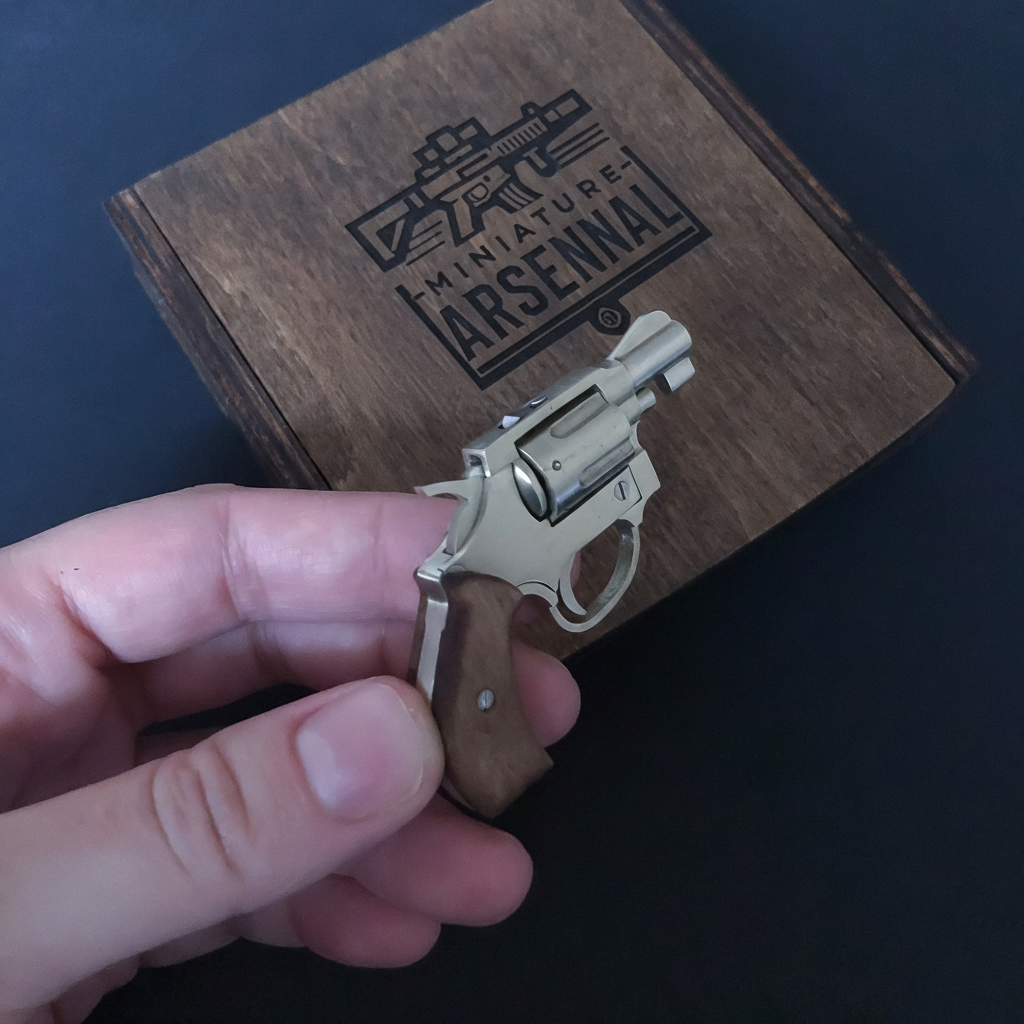
Collectors encounter terms such as fully firing miniature, semi-automatic model, automatic-pattern replica and working miniature. These terms answer different questions. For Smith & Wesson Model 12 miniatures, the model-specific note explains why reference identity and object capability must be separated. This discussion is educational: it does not verify a firing claim from the catalog image, describe operation or recommend acquiring a functioning firearm.
A revolver is a separate collecting category
Revolver terminology should not be collapsed into semi-automatic pistol terminology. The cylinder-centered architecture represents a different reference family even if both miniatures are handheld display objects. A rotating cylinder, when documented, is a model feature rather than proof of firing capability. Catalog the object by reference pattern first, then add only the capability evidence actually available.
Reference design and miniature capability are independent
The reference-family description used in this notebook is revolver pattern. That phrase concerns the represented design, not a verified capability of the miniature. The visible cues, including short revolver barrel and cylinder-centered profile, can help explain resemblance but cannot establish what occurs inside the object. Record the historical reference in one field and the miniature capability evidence in another.
Use terms that describe the evidence precisely
Display-only means the object is documented as a representation without firing capability. Moving-parts describes documented movement and does not automatically imply discharge. Firing describes a separate, model-specific capability claim. Semi-automatic and automatic are more specific operating categories, so they should not be used merely as synonyms for realistic, moving or full-size-inspired. If evidence is missing, unknown is a legitimate record entry.
A photograph is not a capability test
A realistic exterior, a millimeter word in a title or a video caption cannot settle all technical questions about a miniature. Preserve supplied documentation and have object-specific questions assessed by an appropriately qualified professional when necessary. Do not attempt to establish capability by experimentation for a collection record. The useful editorial task is to explain what is supported, what is inferred and what remains unknown.
Notebook checklist
- Keep automatic-pattern separate from documented automatic capability.
- Do not equate moving parts with a firing miniature.
- Avoid transferring full-size specifications to the miniature.
- Leave unsupported capability unresolved.
About the illustration
The image is a MiniatureArsenal catalog photograph labeled “Revolver Smith & Wesson Model 12”. It illustrates the reference discussion; it does not independently verify maker, material, scale or firing capability. The article analyzes collecting evidence rather than certifying the object.